By
By Explore the Majestic Forts and Palaces of Rajasthan
Welcome to a first-time traveler’s guide that breaks down landmark royal sites into a long-form listicle you can scan fast and use to plan a trip. This guide stays in the present tense and focuses on what to look for, what not to miss, and how to experience each place well.
What sets these heritage sites apart is clear: massive hilltop walls, palace interiors with mirror work and murals, and old cities clustered around ramparts. Many are UNESCO-listed, which signals global protection and outstanding value.
This article promises practical tips to choose where to go by interest—architecture, history, or photography—and by route: Jaipur, Jodhpur, Udaipur, Jaisalmer, Bikaner, Bundi, Sawai Madhopur. You will also learn how to spot living-history features like courtyards, audience halls, and women’s viewing windows.
Start here to prioritize visits, time your itinerary, and get the most meaningful experiences from each royal residence and heritage monument.
Why Rajasthan’s forts and palaces are a must-see slice of royal India
Step into these hilltop and lakeside compounds and the past feels present, layered into every arch and corridor. UNESCO recognition flags many of these sites for exceptional preservation, standout design, and deep cultural value—making them safe, rewarding picks for a first visit.
Signature cues to spot on a walk
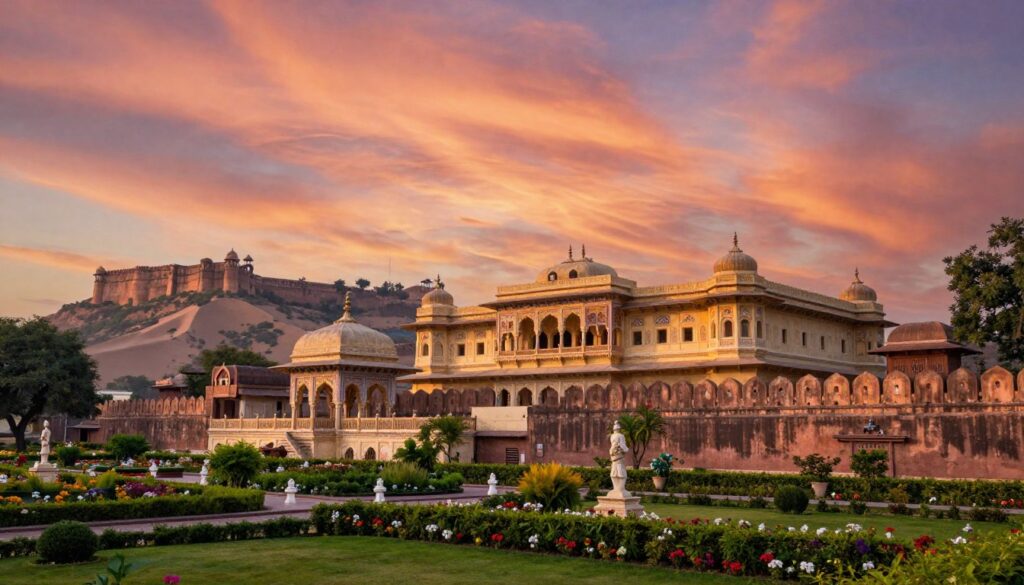
Look for red sandstone facades, marble inlays, and large courtyards meant for processions. Jharokhas—overhanging balconies—balance privacy with views. Small carved details, fountains, and golden ceiling panels reveal the craftspeople’s skill.
How defensive design shapes the visit
Layered gateways, steep approaches, and thick walls now frame dramatic panoramas. These features once protected courts; today they guide your route and create memorable viewpoints for photos.
Experience living history, don’t just read it
Stand in audience halls and imagine court rituals. Listen for acoustic effects in chambers and notice how corridors and courtyards manage movement and shade. Spot the tiny windows used by royal women to watch events unseen.
Each destination blends a different mix of forts palaces—from desert citadels to lakeside retreats—so the next section maps the best picks by interest and region.
Famous Forts and Palaces of Rajasthan you can’t miss on a first trip
Pick sites by what excites you most—ornate carving, battlefield stories, or picture-perfect light. Below is a simple way to match interests with top stops, plus a quick geographic map that helps save travel time.
Best picks by travel style
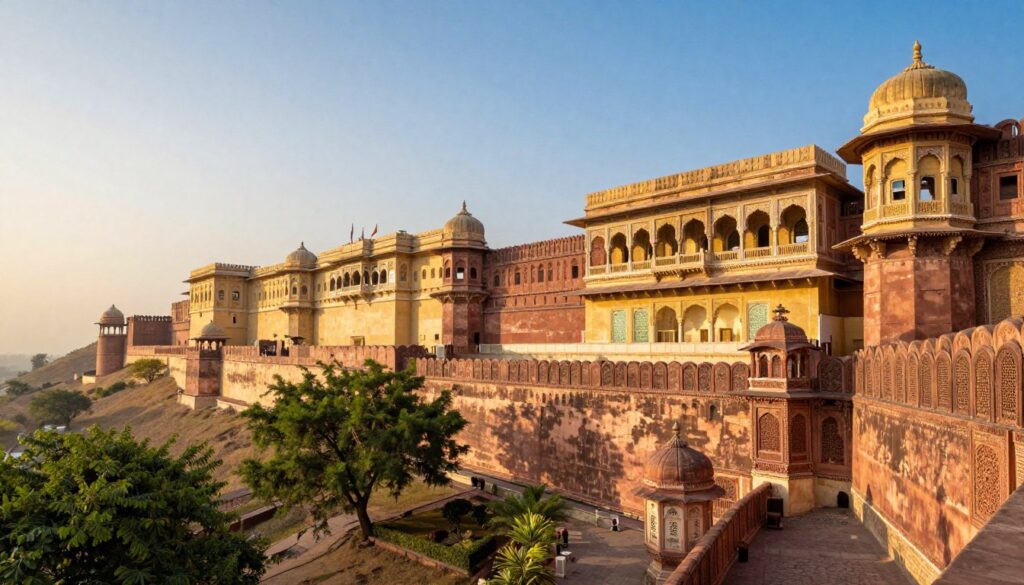
Architecture lovers: Amber and City Palace in Jaipur, Mehrangarh in Jodhpur, and the Lake Palace in Udaipur reward close study of halls, jharokhas, and inlay work.
History buffs: Mehrangarh and Junagarh tell siege and dynasty stories through museums. Ranthambore Fort links royal history to wildlife country.
Photographers: Jaisalmer’s golden sandstone, Jodhpur’s blue-city skyline, and Udaipur’s lake backdrops give iconic frames at sunrise and dusk.
How to group sites by region
Use Jaipur as an easy multi-stop base since the city stacks major icons and nearby defensive forts. The desert cluster—Jaisalmer and Bikaner—sits farther west but pairs well on a single route. Mewar (Udaipur) centers on lake palaces and scenic shots.
Next up: route ideas that link forts palaces rajasthan across major transport hubs for a smooth first-timer circuit.
Amber Fort, Jaipur, where red sandstone meets mirror-work grandeur
Perched above Maota Lake, amber fort feels like a stage set of layered courtyards and carved gateways. Its exterior shows broad walls of red sandstone while interior chambers pair stone with delicate marble inlay.
Key stops to walk through
Begin at Jaleb Chowk and move through Suraj Pol into the public hall. The Diwan-i-Aam served open audiences; notice carved brackets and crowd flow as you tour inside fort.
Private halls and the mirror wonder
The Diwan-i-Khas leads to the sheesh mahal, the classic “wow” moment. Tiny glass panels in the sheesh mahal scatter light to make ceilings sparkle like jewels.
Sukh Niwas, Maota Lake views, gates, and windows
Sukh Niwas shows early cooling tech: channels and breezes keep rooms pleasant. Photographers get best light near Maota Lake at dawn or late afternoon.
Walk the courtyards by Ganesh Gate and spot the small windows where royal women watched parades. The fort traces back to Raja Man Singh I; Amer’s Meena roots and local temple lore explain the name.
“The fort balances strength and grace — a living history above the lake.”
Jaigarh Fort, Jaipur, the “Victory Fort” built to protect Amer
Jaigarh Fort commands the ridge above Amber as a strategic guardian of the palace below. It was built by Jai Singh II in 1726 to secure approaches and ammunition supply lines near Cheel Ka Teela.
The Grand Cannon Jaivana and what makes it famous
The headline here is the Jaivana—one of the largest field cannons ever cast. Visitors get a real sense of scale at the viewing platform beside the barrel, which makes for dramatic photos and a hands-on history moment.
Inside-fort highlights: mandirs, palatial complexes, armor and antiques
Beyond the gun, prioritize the temple pockets and palatial wings. Explore Lalit Mandir, Vilas Mandir, Aram Mandir, and Laxmi Vilas for carved chambers and quiet courtyards.
The galleries inside fort display Rajput armor and antiques that trace military life. These exhibits help you connect the cannon with the people who used it.
Practical note: Jaigarh’s thick walls and militaristic feel contrast with Amber’s residential grandeur. If you’re short on time, pair jaigarh fort with Amber in one outing to see palace and defense back-to-back for a fuller Jaipur story.
“A compact stronghold with big views — Jaigarh shows the city’s defensive backbone.”
Nahargarh Fort, Jaipur, an Aravalli-hills retreat with sweeping city views
Climb the ridge at Nahargarh to see Jaipur spread beneath you, where terraces and ramparts frame wide city views. The site sits on the Aravalli Hills, making it a natural lookout that helps travelers understand the layout of Jaipur at a glance.
Origins and later additions
The main palace began in 1734, built by Maharaja Sawai Jai. Later, Sawai Ram Singh expands parts of the complex in 1868, adding palace wings and sweeping terraces that visitors still explore today.
Part of a defensive network
Look for the long connecting walls—these link Nahargarh to Jaigarh, showing how Jaipur’s forts function as an integrated system rather than isolated sites. That engineered link helped officers move between hilltop posts without exposing the city below.
Why it remains so intact
Unlike many hill forts, Nahargarh fort avoids major battle damage. It never faced a direct assault and even served as a refuge during the 1857 unrest, which helps explain why corridors, balconies, and viewing terraces feel well preserved now.
Practical tip: arrive late afternoon for softer light and a sunset that shifts from city roofs to the Aravalli ridgeline. Pair this stop with Jaigarh and Amber to complete the Jaipur fort trail.
“A hilltop retreat that reads the city: Nahargarh gives context as much as view.”
Mehrangarh Fort, Jodhpur, towering walls above the Blue City
Rising like a stone citadel above Jodhpur, Mehrangarh Fort defines the skyline with sheer presence. Built by Rao Jodha around 1460, it sits roughly 410 feet above the main road, so the height explains its defensive advantage and the city views photographers chase.
Enter through the victory gates—Jayapol and Fatehpol—each named after triumphs by later rulers. The carved gateways still show battle marks, which tell local history at a glance.
The palace circuit is the heart of the visit. Prioritize Moti Mahal, Phool Mahal, Sheesh Mahal, and Daulat Khana to see ornate rooms and royal life preserved inside. If time is short, these rooms capture why several palaces fit into one complex.
The museum inside the fort is a must for history lovers. Look for palanquins, elephant howdahs, Marwar paintings, and the armory. These collections show costume, instruments, and the practical side of rule under different rulers.
“Mehrangarh pairs massive walls with intimate royal interiors—visit for the views, stay for the stories.”
Jaisalmer Fort, the “living” Sonar Qila rising from the Thar Desert
A rare living citadel, Jaisalmer’s Sonar Qila keeps a daily life inside walls that tourists can walk through. Built on Trikuta Hill in 1156 by Rao Jaisal, this fort sits in the Thar Desert and still hosts shops, homes, and a working community.
Yellow sandstone glow and the Golden Fort effect
The yellow sandstone here catches morning and evening light, reading as warm gold across battlements. Photographers find the glow strongest at sunrise and late afternoon.
What to see inside the ramparts
Inside are four major gates, merchant havelis, Jain temples, the Laxminath shrine, and the Raj Mahal near the core. Small museums sit alongside family homes where parts of the royal family maintain ties.
Everyday details that bring the fort to life
Look for carved balconies, narrow lanes, and countless small windows that frame street life. These windows and lanes show how residents mix routine with heritage.
Quick history anchors and visitor tips
Founded by Rawal Jaisal, the fort later faced sieges, including a Mughal attack in 1762 and shifts in control under Maharawal Mulraj. Dress respectfully at temple areas and treat residential zones as living neighborhoods, not just photo sets.
“A living fort is a rare chance to see history used, not only displayed.”
Junagarh Fort, Bikaner, a fort-palace complex rich in royal rooms and museums
Junagarh sits just outside Bikaner as a compact complex where palaces and public rooms stack like chapters in a living history book.
Look and feel: expect courtyards, balconies, and small kiosks finished in red sandstone and marble. The result is a visual timeline where each suite reads differently rather than matching a single era.
Why the layout surprises visitors
The site has seven gates that mark phases of expansion and changing priorities in defense and ceremony. Tradition here favors new construction: many rulers prefer to add rooms instead of sharing predecessors’ chambers.
What to notice
Spot the clear blend of Rajput, Mughal, and British touches—arches and symmetry, ornate surfaces, and later-era fittings that stand out in close view.
Must-see route
Start with the public halls: Karan Palace and Phool Mahal, move through the multi-storied Anup Mahal, then visit Chandra Mahal. Finish at the Ganga Mahal museum so artifacts and labels make the rooms you saw inside fort click into place.
“Junagarh is Bikaner’s living catalogue of rulers and design — small in footprint, huge in variety.”
Kumbhalgarh Fort, the Aravalli stronghold with an epic wall and hundreds of temples
Walkable ramparts and a forested backdrop make Kumbhalgarh a fort that rewards slow exploration. Founded by Rana Kumbha in the 15th century and now a UNESCO site, the complex pairs military scale with spiritual density.
The 36 km wall and multi-gateway defenses
The fort is famed for a roughly 36 km wall—often noted after the Great Wall. The wide ramparts are walkable and create framed viewpoints. Six main gateways add layered defense and dramatic approaches for visitors to trace.
Temple landscape: Jain and Hindu shrines
Inside the ramparts lie more than 360 temples—about 300 Jain and 60 Hindu. The mix shows how devotional life grew alongside military needs, and small sanctuaries sit amid courtyards and halls.
Maharana Pratap’s birthplace and a living royal timeline
Born here, Maharana Pratap anchors local history. Successive rulers kept the site in use into the 19th century, so you see layers of change across rooms and restoration work.
Festival vibes and ways to explore
Attend an evening light-and-sound show when possible. Join guided heritage walks to hear context you won’t get from quick stops. The fort rewards unhurried visits.
“Kumbhalgarh reads as engineering plus spirituality—long walls that protect a dense temple landscape.”
Ranthambore Fort, where history meets Ranthambore National Park
A hilltop stronghold that doubles as a wildlife vantage point, ranthambore fort rewards both history lovers and nature fans.
UNESCO, setting, and iconic sunset views
The site sits near Sawai Madhopur inside ranthambore national park, so the approach feels like a safari. UNESCO added it in 2013 for blending military design with a natural backdrop.
From the ramparts, sunset paints the forest vermillion and frames memorable photos over teak and sal woodland.
Dynasty layers and key events
The fort starts around the mid-10th century under Chauhan builders, linked to Hammir Dev. Iltutmish captured it in 1226; Chauhan forces retook it in 1236. Later reconstructions leave visible layers of change under successive rulers.
Temples, Jain links, and practical tips
Inside are temples with Jain ties, including Siddhesenasuri and a Mallinatha shrine. Respect worship spaces when you visit.
Pair a morning wildlife drive in the national park with an afternoon at the fort near Sawai Madhopur. It is one of the clearest places to feel how geography, defense, and devotion intersect.
“Ranthambore is a rare two-for-one: deep heritage set inside living wilderness.”
Plan your Rajasthan fort-and-palace trail like a pro
Plan a connected route so each stop builds on the last. Cluster days: Jaipur city (Amber, Jaigarh, Nahargarh plus Hawa Mahal and City Palace), Jodhpur, Jaisalmer, Bikaner, Udaipur (Lake Pichola and the Lake Palace), and Sawai Madhopur for the fort and park.
For Jaipur essentials, pair the City Palace visit with Hawa Mahal’s 953 windows to get royal-residence context and street-view contrast. In Udaipur, use Lake Pichola as a calm palate cleanser; the Lake Palace began as an 18th-century summer palace (1743–46).
Choose pacing: do back-to-back hill forts in Jaipur’s defense network, but spread palace days in Udaipur. Photographers time Nahargarh and Jaisalmer for golden hour. Wear good shoes, carry water, and allow extra time inside fort museums to read labels. Treat this as a checklist: each fort also explains the next, so build the trail as a single, connected heritage story.